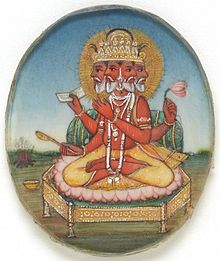
TYPE: Creator God
ORIGIN: Hindu - India
KNOWN PERIOD OF WORSHIP: Circa 500 BCE or earlier until present day.
SYNONYMS: Many epithets including Abjaja, Abjayon, Astakarna, Kamalasana, Prajapati, Svayambhu, Virinchi
CENTER(S) OF CULT: Restricted since circa 700 CE to two sanctuaries—at Lake Puskana in Rajputana, and at Idar near Mount Abu.
ART REFERENCES: Sculptures generally in bronze but also in stone, reliefs.
LITERARY SOURCES: Mentioned in Rg Veda, but properly from Ramayana epic and from Puranic texts.
AFFILIATION: Trideva, Deva
ABODE: Satyaloka or Brahmaloka
MANTRA: Om vedatmanaya vidmahe hiranyagarbhaya, dhimanhi tan no brahma pracodayat.
WEAPONS: Brahmastra, Brahmashirsha astra, Brahmanda astra
SYMBOL: Lotus, the Vedas, Japamala, and Kamandalu
MOUNT: Hamsa (bird)
FESTIVALS: Kartik Purnima
SIBLINGS: Lakshmi
CONSORT: Saraswati
CHILDREN: Mind-Born children including Angiras, Atri, Bhrigu, Chitragupta, Daksha, Himavan, Jambavan, Kratu, Kumaras, Marichi, Narada, Pulaha, Pulastya, Shatarupa, Svayambhuva Manu, and Vashishtha
INFORMATION: With Visnu and Shiva, Brahma is one of a trinity of supreme creator deities in the Hindu Pantheon. His consort is generally the goddess of wisdom, Sarasvati, but some sources identify the goddess of speech, Vac. He also has a second consort, the milkmaid Gayatri. Originally the title referred to the power of occult utterances that became associated with the priests or Brahmans.
Brahma is depicted with four heads, often bearded, facing in four directions, and with four hands, sometimes with one of them raised in blessing or promise. As a god of knowledge he often carries the Vedas (early Sanskrit mythology said to have sprung from his head) in one of his hands. Other attributes include a water pot indicating prosperity, a spoon or a string of pearls. He may also carry a staff and an alms dish. He may be depicted with red or pink skin, wearing a white robe or loin cloth with a sacred cord across the shoulder. His sacred animal is the goose.
According to one legendary source he was created from the right side of the primordial creator force. His live is anticipated as a hundred heavenly years, each of 360 days and nights, Each day, or Kalpa, is equal to 4,320,000 earthly years. Brahma's current age is said to be fifty-one and after each of his years, the universe is destroyed and rebuilt.
Brahma is generally less popular than Visnu or Siva, probably because he is identified solely with the primordial account of creation. Legend describes how he created himself from the primeval waters using the power of his own desire. He thought a seed into existence, which grew into a golden egg and from which he emerged after a year. The two halves of the shell became heaven and earth, within which he fashioned the sky. The Ramayana also describes him in the form of a boar that raises the earth on its tusks. By contrast the Mahabharata accounts him born from a lotus in the navel of Visnu. Elsewhere he emerges as a fish, or as a tortoise. Negative aspects of Brahma include drunkeness and duplicity.
One source describes how the beautiful goddess Satarupa was formed from half of Brahma's own self but that in an attempt to prevent him looking on his daughter with incestuous desire, she circled around him. His four heads resulted. There was once a fifth which Siva decapitated with the thumb of his left hand. It is said that incest with his daughter is also partly responsible for Brahma's limited worship. Alternatively legend credits him woth a daughter, Vach, by whom he fathered the living world.
In Buddhist tradition, he is also one of a group of dharmapala with terrible appearance and royal attire.